Anonymous
God I love this sentence so much. Or is it a line? If you don’t mind, I’ll close read it, and perhaps from there something will emerge that might be of use to you or to someone.
This line comes anonymously (and from no place!) and so it carries with it a sense of an engraving, like something you might find carved into a rock or tree, or conversely something ephemeral—a song lyric you catch out of an open car window on a humid night.
Its lack of punctuation marks it as contemporary—dashed-off electronic text—but formally this choice allows the three parts of the utterance/confession to meld together into a substance. It makes it almost riverine. The words lose their identities, becoming each other.
I must pluck out its three movements one by one
I think
im in love
for real
by almost squinting. When I consider them separately, I am able to see how the sequence of thoughts reverberate, complicating each other.
Your letter reminded me of the first line of one of my favorite poems by John Ashbery, “An Evening in the Country.” He begins this poem with a statement that was once described (I forget by who! It was maybe David Shapiro?) as one of the most depressing opening lines ever written:
I am still completely happy.
There is no way anyone could read this line and believe that the speaker is happy or was happy. The “still” (time, stillness, stasis) and completely (the impossibility and hyperbole of such a word) erode the assertion of happiness.
I don’t think your line is at all depressing or that you aren’t in love. But I do love the ways in which your (and Ashbery’s) word choices reveal the shadows of their thinking. As with Ashbery’s line, where the “still completely” screams over the phrase it interrupts, “I am … happy,” what we might call the meat or heart or argument of your sentence (“I’m in love”) is arguably its least interesting aspect, a material we must move through between “thought” and “the real”. Its movements perform the kind of swerve or lurch we do in the sickness of love (and poetry). But if we look into its more affective qualities we also might see ambivalence, hesitation, even a tug-of-war between mind “I think” and body, the corporeality of “for real.” Abstraction and physical reality are set at either end of the statement “I’m in love,” which feels momentarily emptied of meaning.
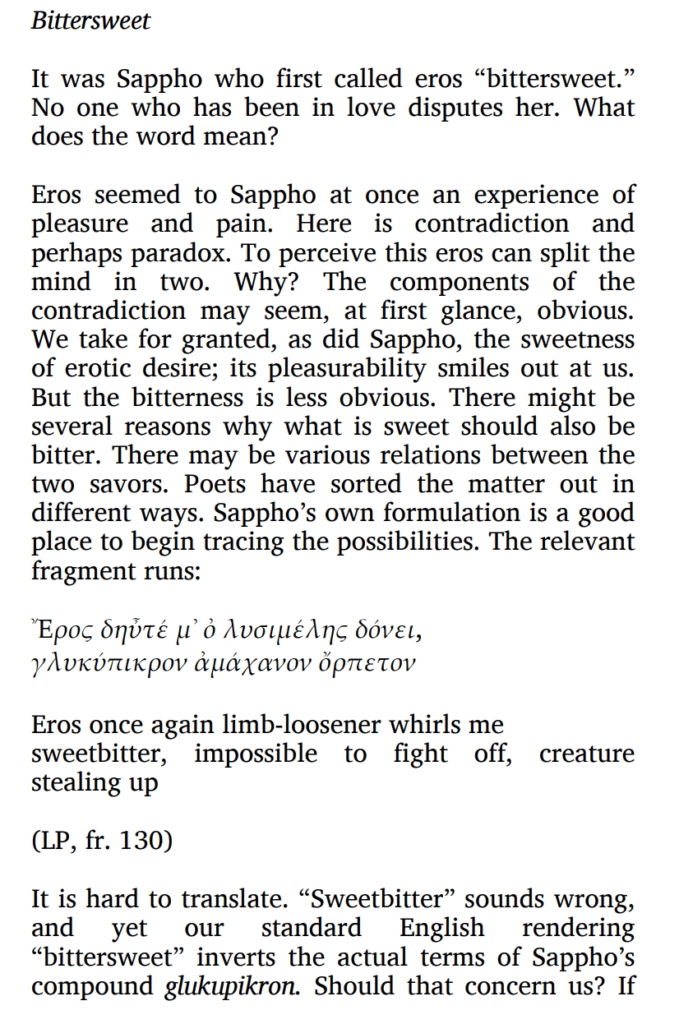
I might direct you towards Anne Carson’s incredible Eros the Bittersweet, for her discussion of the ways the Ancient Greek poets described this feeling.
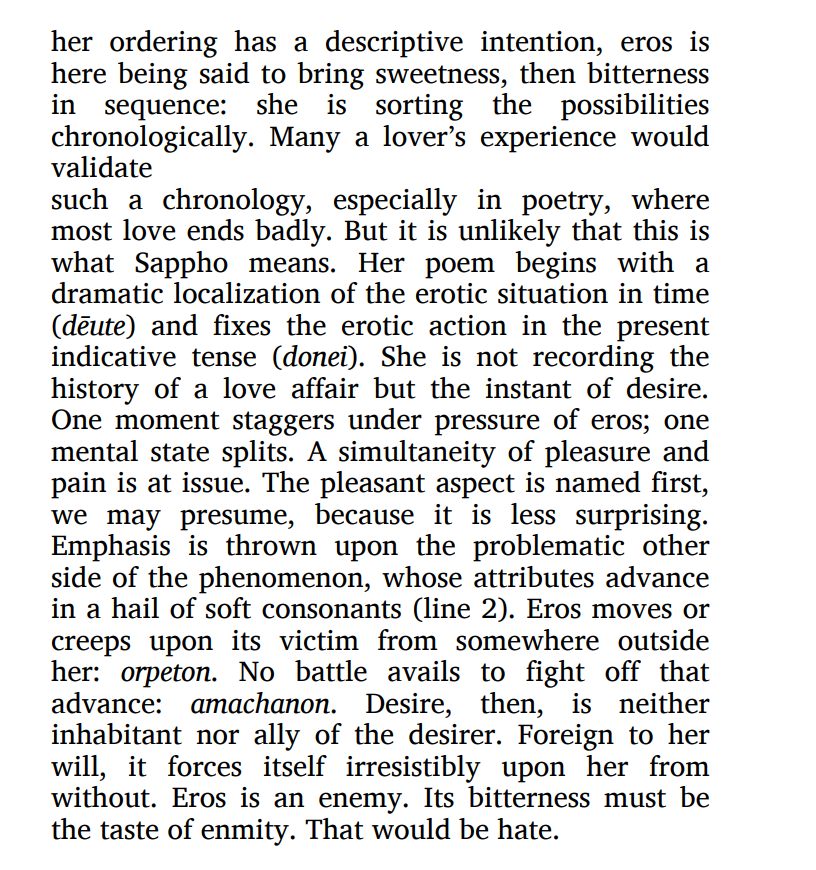
and later
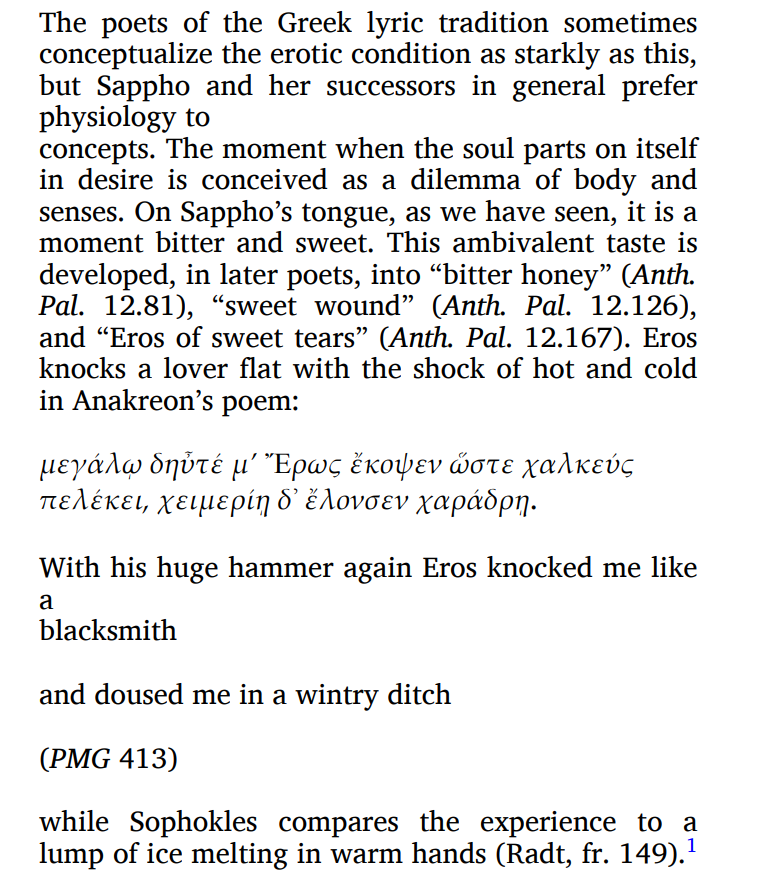
The last thing I will say about your incredible line is that it feels like it’s written or whispered to a friend. The beloved remains ghostly in the text, but I feel a “you,” a trusted addressee that you are talking to. I guess that could technically be me, but I like to imagine you are talking to a friend, or the air. I’m happy for you. This feeling you describe is turbulent and special and strange and rare. When I remember feeling this way it was like living, for a while, inside an electrified syrup.
Small Playlist (dashed-off and in no way comprehensive)
Eros the Bittersweet by Anne Carson
“Do You Want to Dip the Rat” by Dorothea Lasky (will we or won’t we?)
The Gift & The Correspondence Artist by Barbara Browning (especially for thinking about love, reality, the body, and correspondence)