Anonymous, PA, USA
A poet once asked, though in statement form, “Does that which is unrecognized in the poem make the work more forbidding or more beckoning.” Life these middling years is a long commute, a swinging office door of voices and vendettas, two beloved curly-haired boys in the rearview mirror, stacks of dry-cleaning in an empty front hall. Can poetry make this more beckoning, more recognizable, less forbidding? – Anonymous, PA
Dear Anonymous,
Yes. But I suppose you would then ask “how?” But maybe the how is not so important, it’s the yes that matters. A leap of faith. Viktor Shklovsky, the Russian Futurian, wrote about the value of defamiliarizing –– make strange. You are already doing this, and beautifully, with your “Life these middling years is a long commute, a swinging office door of voices and vendettas, two beloved curly-haired boys in the rearview mirror, stacks of dry-cleaning in an empty front hall.” By making this list somewhat, you’ve both defamiliarized and made intimate. It’s like you cast a light particular of everyday life – but aslant. I write about this most fully in Artifice of Absorption, where I explore how opacity in a poem can make it work more like a charm than a plot.
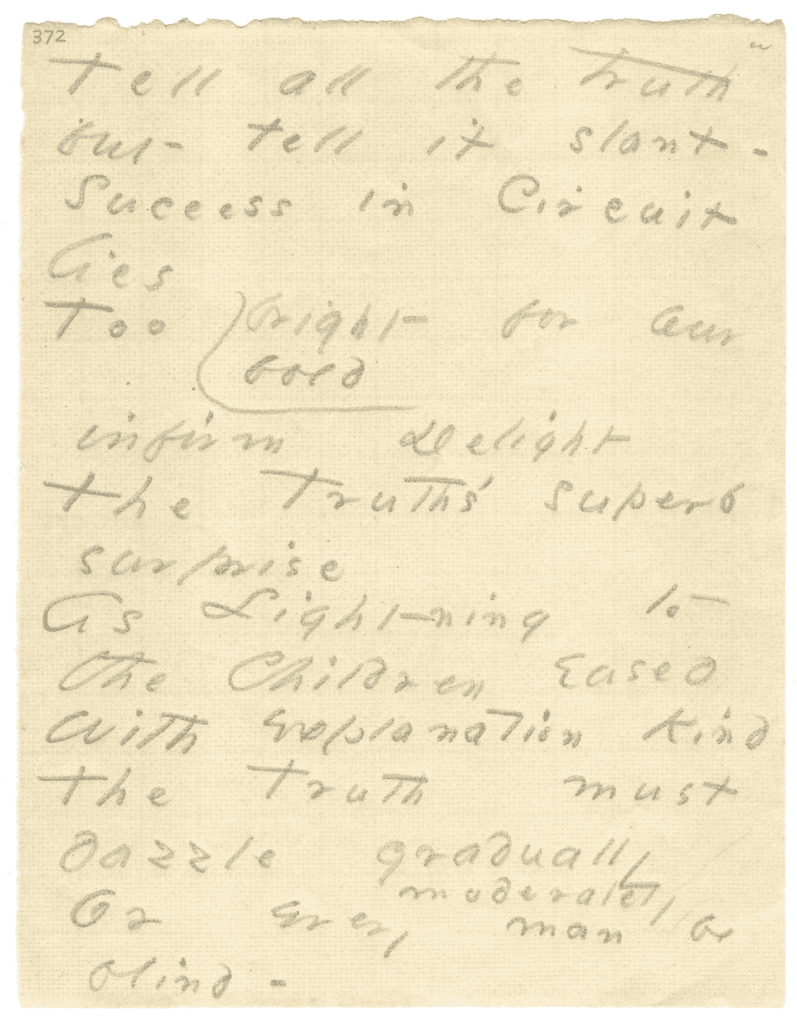
The locus classicus for this approach to poetics is Emily Dickinson’s early 1870s poem ––
tell all the truth
but tell it slant –
Success in Circuit
Lies
too bright for our
bold
infirm Delight
the truth’s superb
surprise
As Lighting to
the Children Eased
With explanation kind
The Truth must
Dazzle gradually
moderately
Or every man be
blind ––
For Dickinson, the truth all at once would be blinding, which is to say, forbidding. But aslant (associated with “surprise” and indirection as “circuit”), truth beckons (what ED calls “success”). The aesthetic trick is to devise the right angle: not approach the subject head-on. Does seeing a typographic version hewing to the holograph make this work more or less inviting than if we tidied up the format? The truth is the uneven texture, the space between the words. The gradual unfolding of the meaning.
Dickinson speaks directly of beckoning in the sense you are asking about, in a poem from a decade earlier (excerpt):
This World is not conclusion.
A Species [sequel] stands beyond –
Invisible, as Music ––
But positive, as Sound -–
It beckons, and it baffles -–
Philosophy, don’t know –-
And through a Riddle, at the last —
Sagacity, must go —
To guess [prove] it, puzzles scholars —
To gain it, Men have borne
Contempt of Generations
..…
This great ode to what George Oppen called “being numerous” suggests that what beckons is precisely what first baffles: to get to the music, you need to confront the sound—the aesthetic materiality of the poem.
Your question starts with a quote from something I said in response to a question by Marjorie Perloff in a 2003 interview, appropriately titled for this discussion, “Poetry Scene Investigation” (collected in Attack of the Difficult Poems, University of Chicago Press, 2011). In that conversation, I quote a poem from William Cowper’s The Task (1785), which, along with the ED poems, is my RX:
When Winter soaks the fields, and . . . feet
Too weak to struggle with tenacious clay,
Or ford the rivulets, are best at home,
The task of new discoveries falls on me.
At such a season and with such a charge
Once went I forth, and found, till then unknown . . .
The poem is a gift unfolding in the otherwise forbidden words of its beckoning. If the task of poetry is “new discoveries,” what is the task of criticism? In my conversation with Marjorie Perloff, I say, “poems cannot be left to their own devices.” Perloff’s work is a guide to the perplexed, where perplexed is both bewildering (in the wild) but also off-putting or forbidding in the sense you ask about. I know you are asking about a transvaluation of perception, not poems; but some poems can open the doors of perception. Perloff’s books offer many ways to turn what may seem like a forbidding poem into pure delight. Rx: The Futurist Moment (University of Chicago Press, 1986). Here’s a poem I wrote for Perloff’s 90th birthday. It will appear in my next book, Dodging, forthcoming from the University of Chicago Press. So, as I end my rounds at The Poetry Clinic with this: Go, figure.
Go Figure
Translation precedes
poetry. In
other’s words
interpretation’s not
the end
of criticism
but a
place for
art. Meanings
follow utterance
hoping for
one more
chance at
bat. (Poetry
written as
affirmation will
never acknowledge
apostasy.) Interpretation
like translation
can be
wrong –– but
you won’t
know till
the crying
starts. Dark’s
part light,
it’s just
you can’t
see it.
(We keep
reinventing the
wheel because
we’re stuck.)
If critics
didn’t exist,
we would
have to
invent them.
Piety’s impious.
Not agency:
adjacency.
So here is my charge to you as I finish my stint at the Poetry Clinic:
Go, figure.