Broccoli, Canada
Winter is my favourite season. It’s my favourite season because I get to play in the snow and do snow angels and drink hot cocoa and go skiing and have snow ball fights! Can you write me a poem about winter?
Sincerely,
Broccoli
Dear Broccoli,
Yes! Play! Dream!
Thank you for writing to me, oh favorite vegetable, and reminding me to love the creeping dark.
I must admit, b, that winter has never been my favorite season. I rather despise the cold. But here’s the thing: despite myself, my nature, the season of the night has earned my fierce respect.
Wait – the thing is that it’s not despite my nature at all!
(Self-awareness can dawn so slowly, like winter’s light.)
There was the year I surprised myself by falling deeply in love with winter’s morning light. A night person, I found myself up early day after day, unable to resist the sharp angle of sunrise.
I’ve recently found myself surprised to be surrounded by so many snows! They reminded me how some of my favorite music is what I call snowquiet: a hush, a silence found nowhere near anything in bloom. The Japanese call it shinshin, something to listen to from the mind, not the ears. Something heard by the imagination.
So, to poetry. As I began this sort-of-letter to you, broccoli, I couldn’t get one of my favorite poems out of my mind. Adrienne Rich’s “Diving into the Wreck” speaks to so much of us – it amazes me that I’d never before thought of it with regard to winter. And yet…and yet… I’ve copied it at the base of this letter. It’s worth climbing down its ladder, trusting that the depths will lead us toward light.
Anyway, here are a few of my meditations on winter:
One thing winter sho’nuff does – or used to, or once did – is keep its word.
Winter freezes grammar and strips down adornment so that all we’ve left is the blink blink blink of our own insistent artificial lights.
Winter doesn’t ask permission.
Winter comes at night and stays there.
Winter refuses the performance of growth.
Winter knows that death, too, is sacred renewal.
Winter’s ground closes its fist and calls us to rest.
Winter won’t let us mistake quiet for absence.
Winter seasons our honesty and rewards our deepest listening.
Winter teaches us that what lies dormant doesn’t disappear.
Winter encourages endurance sans heroics.
Winter can linger without clinging.
Winter can press without crushing.
In winter, we begin to store a future we can’t yet name.
Under its starry dark, our attention sharpens. Sound travels farther. Footsteps crunch their unsurprise.
In December, I can see my breath float near solidity. Proof of life despite tight constraint.
By February our own interior weather alarms us.
Trust the cycle as truths step forward: what matters; what holds.
Take inventory of what remains warm. Protect what remains alive of us beneath the surface, feeding off of our fluff.
Have faith in the long work that happens beneath and beyond applause.
And when the buds come, recognize their miracle: all that labor, finally ready to breathe.
——————————-
Winter works in stages:
First, it takes us down into the dark and teaches us how to hold heat. Then it sharpens our sense of direction, demands that we aim without moving. Then comes the real hard work: bracing, bearing weight, keeping the structure intact when everything ornamental falls away. Old systems crack under pressure, and new thoughts spark. The cold reorders what it reserves. And finally, what has been held too tightly is allowed to soften. Grief moves. Dreams return. Our bodies finally remember liquid water.
——————————-
Don’t mistake the long dark for an ending.
Blackness holds what cannot survive exposure.
Darkness knows what grows best without witness.
Our roots do their most serious thinking here.
Nothing blooms on command. Nothing hustles.
Every day’s dark arrives just a bit earlier.
Edges blur their protection of what we cannot yet name.
Certainty loosens. Everything prepares.
Trust the long night. Trust the ember to remember what flame can be.
Direction sharpens its aim beneath the night.
Let the depth do its job.
Let the body relearn its ember-work.
Our work is to bank the fire without wasting it.
Our work is to read warmth by touch alone.
Pain speaks more clearly at night, but so does memory. So does want.
Some seasons require descent before they allow alignment.
Some nights exist to teach us where to point next.
Spring doesn’t arrive as a surprise. We earn it.
——————————-
Oh, broccoli!
I just knew that my response to your letter would be the one that’d be most quick and sure. And yet – And yet –
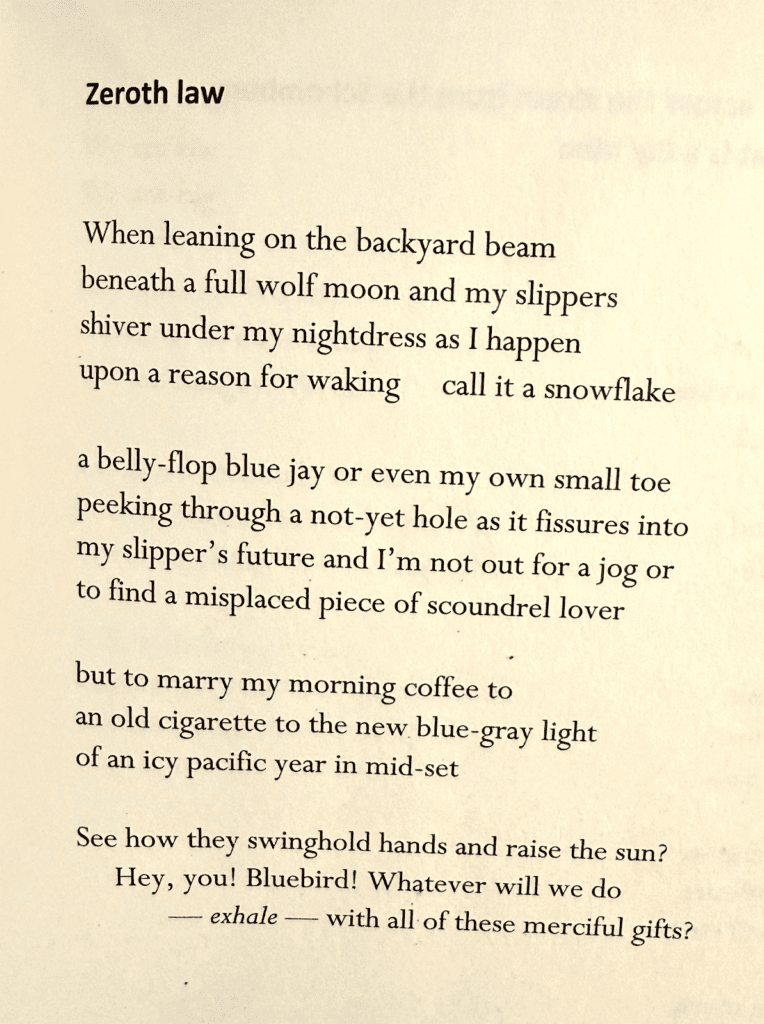
You’ve asked me to write you a poem. Perhaps I have. What I know is that I can share one which I’ve written, which reminds me of this strange love of the long night:
by Samiya Bashir
When leaning on the backyard beam
beneath a full wolf moon and my slippers
shiver under my nightdress as I happen
upon a reason for waking call it a snowflake
a belly-flop blue jay or even my own small toe
peeking through a not-yet hole as it fissures into
my slipper’s future and I’m not out for a jog or
to find a misplaced piece of scoundrel lover
but to marry my morning coffee to
a cigarette to a new blue-gray light
an icy pacific year in mid-set
See how they swinghold hands and raise the sun?
Hey, you! Bluebird! Whatever will we do
– exhale – with all of these merciful gifts?
——————————-
** Scorpio pressurizes what Pisces must release. **
Finally, broccoli, I find poetry in the turning wheels of the zodiac. Winter’s signs offer us a map. Sometimes, when we feel lost in the long dark, the stars can light the way across Winter’s arc:
Scorpio: Winter’s sealed depth. Incubating dark. Go down deep.
Sagittarius: Winter’s calibration. Inner compass. Direction. Aim your arrow.
Capricorn: Winter’s bone. Load-bearing patience. Endurance. Begin to build.
Aquarius: Winter’s rebellion. Electric cold. Reinvention. Reimagine our collective leap.
Pisces: Winter’s dissolving edge. Surrender without defeat. Release. Dream our next, new world.
——————————-
And now, before the light’s inevitable return, let’s dive:
Diving into the Wreck
by Adrienne Rich
First having read the book of myths,
and loaded the camera,
and checked the edge of the knife-blade,
I put on
the body-armor of black rubber
the absurd flippers
the grave and awkward mask.
I am having to do this
not like Cousteau with his
assiduous team
aboard the sun-flooded schooner
but here alone.
There is a ladder.
The ladder is always there
hanging innocently
close to the side of the schooner.
We know what it is for,
we who have used it.
Otherwise
it is a piece of maritime floss
some sundry equipment.
I go down.
Rung after rung and still
the oxygen immerses me
the blue light
the clear atoms
of our human air.
I go down.
My flippers cripple me,
I crawl like an insect down the ladder
and there is no one
to tell me when the ocean
will begin.
First the air is blue and then
it is bluer and then green and then
black I am blacking out and yet
my mask is powerful
it pumps my blood with power
the sea is another story
the sea is not a question of power
I have to learn alone
to turn my body without force
in the deep element.
And now: it is easy to forget
what I came for
among so many who have always
lived here
swaying their crenellated fans
between the reefs
and besides
you breathe differently down here.
I came to explore the wreck.
The words are purposes.
The words are maps.
I came to see the damage that was done
and the treasures that prevail.
I stroke the beam of my lamp
slowly along the flank
of something more permanent
than fish or weed
the thing I came for:
the wreck and not the story of the wreck
the thing itself and not the myth
the drowned face always staring
toward the sun
the evidence of damage
worn by salt and sway into this threadbare beauty
the ribs of the disaster
curving their assertion
among the tentative haunters.
This is the place.
And I am here, the mermaid whose dark hair
streams black, the merman in his armored body.
We circle silently
about the wreck
we dive into the hold.
I am she: I am he
whose drowned face sleeps with open eyes
whose breasts still bear the stress
whose silver, copper, vermeil cargo lies
obscurely inside barrels
half-wedged and left to rot
we are the half-destroyed instruments
that once held to a course
the water-eaten log
the fouled compass
We are, I am, you are
by cowardice or courage
the one who find our way
back to this scene
carrying a knife, a camera
a book of myths
in which
our names do not appear.